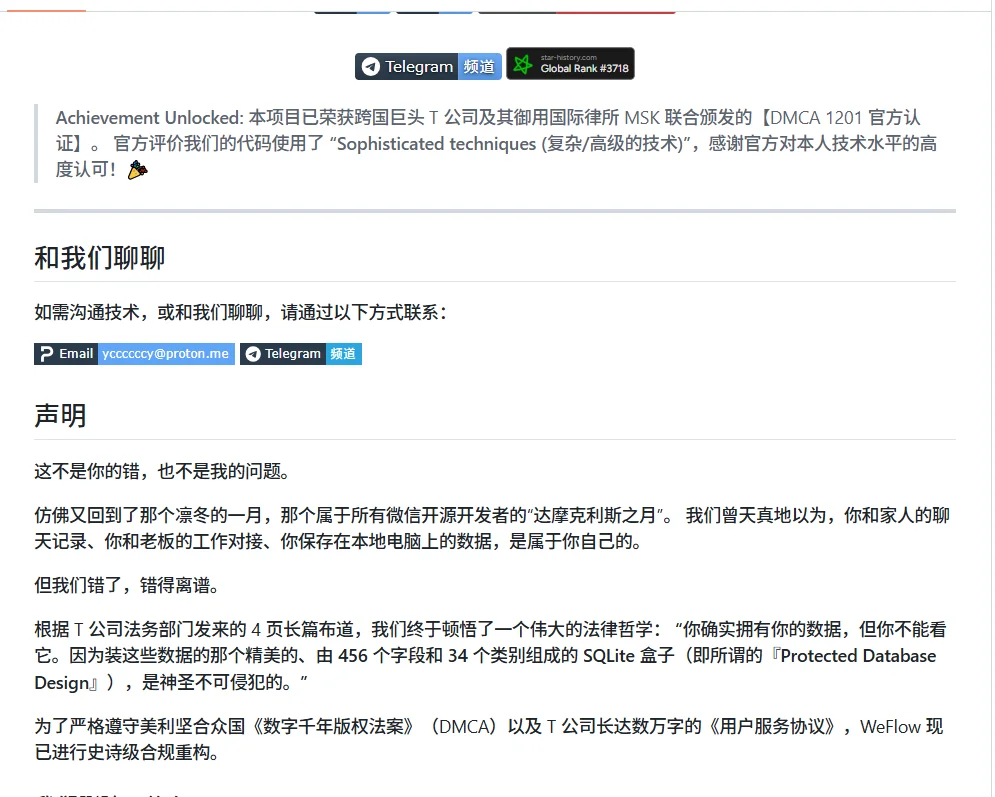
WeFlow is gone. Open the repo and the code is wiped. One README and a single image are left behind. The commit that reads Replace repository with DMCA notice serves as the epitaph. Fourteen thousand stars, 467 forks, the work of 38 people. Erasing it takes a moment.

What WeFlow did was not complicated. It read the database WeChat keeps on your own machine, exported your chat history, and built an annual report out of it. Everything ran locally and no data left the device. Backing up your own records should be a matter of course. But T Company's legal department sent down four pages like a sermon, and in it lives a grand legal philosophy: you do own your data, you just are not allowed to see it. The SQLite box that holds it, with its 456 fields and 34 categories, is a Protected Database Design, sacred and inviolable. When the sermon ended, the DMCA 1201 notice landed, and the project was gone.
The author did not curse. He turned the README into dark humor. After deep soul searching, it says, WeFlow now ships a pure telepathy chat history export feature. Close your eyes and recall yesterday's conversation. Fully compliant. There is also Schrodinger's data browser. As long as you never read it, your chat history remains in a superposition of existing and not existing. The jokes are good ones. You just cannot laugh.
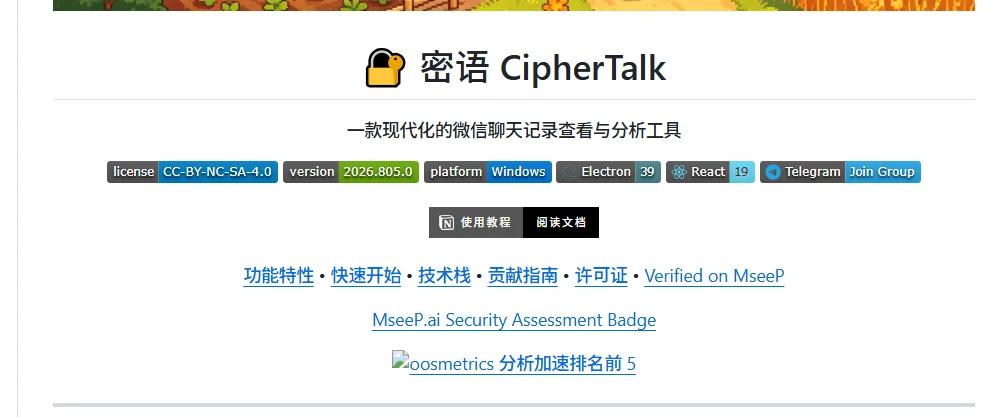
This is no isolated case. WeChatMsg, WeChatClean and EchoTrace fell one after another. Countless WeChatExporter repos are left with nothing but a 404. Every repository that tried to hand users back their own data died the same death, under a lawyer's letter. Poke the undefeated legal squad and there will be blood. The survivors learned their lesson. A similar tool, CipherTalk, carries a repo description of four words: nobody here by that name. Those who hide their edge stay alive.
The environment cooperates. Someone asks on social media how to export a chat history and gets a reply: export it for what, are you planning a crime? To back up your own things you must first prove your innocence. We have grown used to this air.
Control everything, prevent nothing
Domain registration is another specimen. To run a proper website in this country you first pass the ICP filing. The paperwork is thorough enough for a police interrogation. Two weeks if things go well, a month or more if they do not. The code was finished long ago, but the launch must wait for a stamp. Development time burns away on forms and queues, all, they say, for your own good.
The nerves of regulation are drawn tight. Sensitive word lists turn over every few days. The review criteria leave no trace to follow. The same passage passes today and is deleted tomorrow. Every inch is guarded and nothing gets through.
Yet the Silver Fox phishing sites stand unscathed. Fake official sites, fake customer service, fake login portals. One batch of domains falls and the next batch goes up, a business run with years of discipline. Honest people have their lives turned inside out while scammers change domains like clothes. It can keep good people from going online and cannot keep bad people from working. This kind of regulation arrests the wrong people.
Your data lives on someone else's goodwill
WeFlow's disappearance surprises no one. On this soil, data freedom is extra curriculum. Your chat history, your files, everything on your hard drive belongs to you less than it lives on the platform's goodwill. When they let you look, you may look. When they do not, telepathy is your only export channel.
Code can be deleted. Forks cannot. The README is still there, 467 forks are still there, the Telegram channel is still there. At the end of the README the author wrote, so we row on, boats against the current, back to the days of old. A twist on the closing line of Gatsby. In this place, it fits perfectly.
Thanks for all the fish.